

The Arabic coffee tradition is one of the oldest acts of hospitality the world has ever known, a ritual so deeply woven into the fabric of daily life across the Arabian Peninsula that to refuse a cup is considered a quiet refusal of the host themselves. Long before coffee shops existed, before baristas, before single-origin tasting notes appeared on paper bags, there was the dallah, a long-spouted brass pot sitting over a low flame, filling the air with the warm, cardamom-laced scent of qahwa. That aroma, green or lightly roasted coffee steeped with cardamom, sometimes saffron, sometimes clove, was not merely a smell. It was an announcement: you are welcome here.
Qahwa: The Coffee That Speaks Before You Do
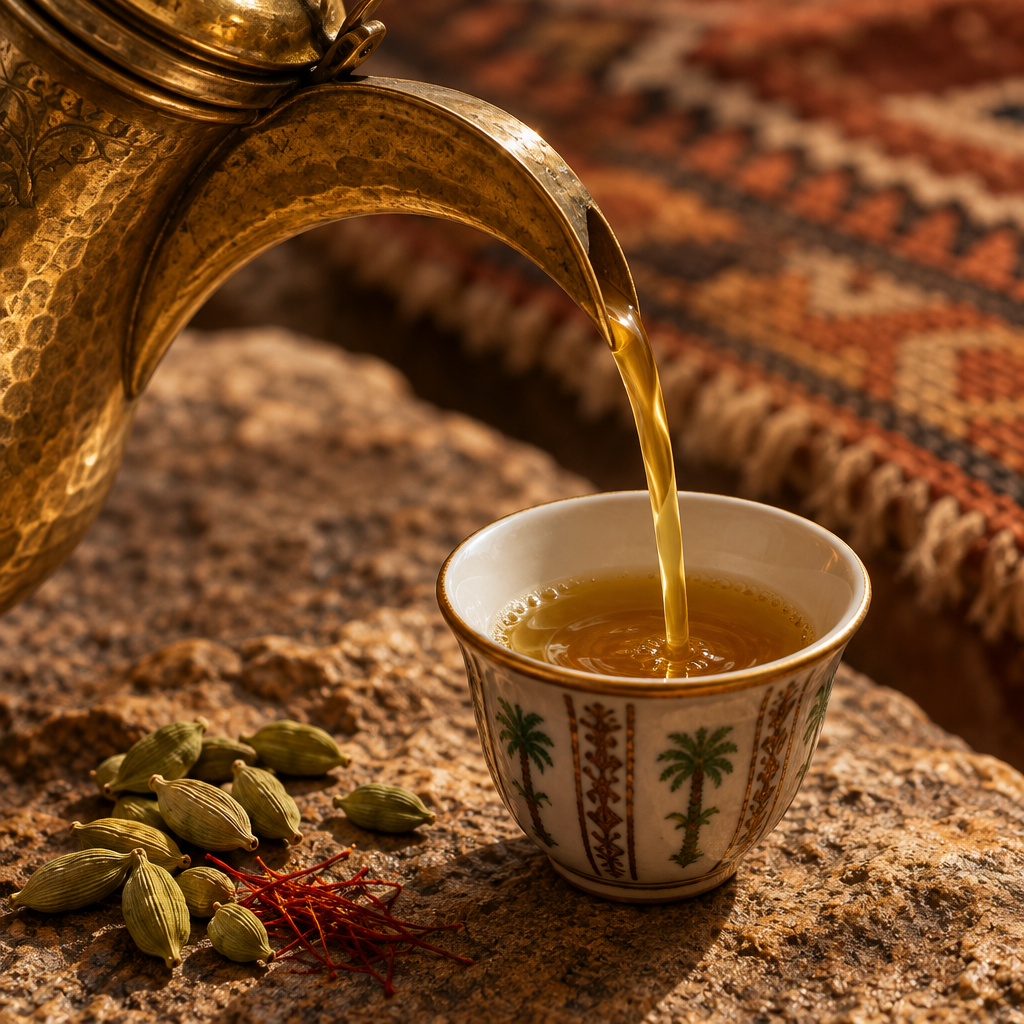
Qahwa, the Arabic word for coffee and also the root from which the English word itself derives, is at the centre of this tradition. Unlike the dark espresso pulls familiar to Italian cafes or the cold brews favoured across modern Bangkok, qahwa is characteristically pale, golden, or pale green in colour. It is brewed from lightly roasted or unroasted green coffee beans, ground coarsely and simmered slowly with whole cardamom pods. The result is a drink that is delicate rather than bold, aromatic rather than bitter, and deliberately low in caffeine so that a guest may accept cup after cup without offence or overstimulation.
The finjan, a small handle-less cup, is filled only partway, never to the brim. This is not accident or poor measure. The partially filled cup is an invitation to ask for more, a small social choreography that keeps the conversation flowing and the host engaged. A guest who has had enough gives a gentle side-to-side shake of the cup, a gesture as eloquent as any word. In this way, qahwa becomes less a beverage and more a structured language of giving and receiving, of knowing when to offer more and when to let go.
The spices used in qahwa carry meaning as well as flavour. Cardamom is the dominant voice, warm and slightly floral, believed to aid digestion and calm the spirit after a long journey. Saffron, when added, lends a golden hue that signals special occasions and generous hosts. Clove and ginger appear in regional variations from the Hejaz to the Gulf, each household recipe a small fingerprint of place and lineage. This layering of spice is not decoration. It is knowledge passed through generations, the way a family might teach its children to greet elders or set a table.
The Majlis and the Architecture of Welcome
To understand the Arabic coffee tradition fully, you need to understand the majlis, the Arabic word for a sitting place, and the social institution it describes. The majlis is the room or space where guests are received, disputes are settled, news is shared, and community is maintained. In Bedouin culture, before permanent structures made such things easy, the majlis was assembled from rugs and cushions under open sky. Coffee was inseparable from this space. It was the first thing offered upon arrival and the last thing cleared before departure.
Hospitality in this tradition operates by a strict moral code. A host who fails to offer coffee to a guest has failed in something fundamental, something that goes beyond manners into the realm of character. The word for a generous, hospitable person in Arabic, karim, is one of the most valued compliments one can receive. And the act of pouring coffee, of holding the dallah attentively, of watching for the moment a cup needs refilling, is an expression of that kareem spirit made physical. Wealth was historically measured not by what you kept but by what you gave away, and coffee was one of the most immediate, daily expressions of that ethic.
Today, the majlis continues in living rooms across Saudi Arabia, Kuwait, the UAE, Qatar, and beyond. Businesspeople conduct negotiations over qahwa. Families gather for it after Friday prayers. It accompanies dates, the sweetness of the fruit balancing the slight bitterness of the brew in a pairing so classic it has become almost synonymous with the tradition itself. UNESCO recognised the Arabic coffee tradition, known formally as qahwa, by inscribing it on the Representative List of the Intangible Cultural Heritage of Humanity in 2015, a recognition not just of a drink but of the entire social architecture it sustains.
Spice, Travel, and the Journey of Flavour
Coffee itself began its journey in the highlands of Ethiopia, but it was the Arab world that transformed it into a civilisation-shaping ritual. Yemeni traders brought coffee cultivation from Ethiopia to the port city of Mocha in the fifteenth century, and from there it travelled along trade routes to Mecca, Medina, Cairo, and Istanbul. The coffeehouses, or qahveh khaneh, that spread across the Arab and Ottoman worlds in the sixteenth century became centres of intellectual life, places where poetry was recited, music played, and ideas debated. Long before the concept of the café existed in Europe, Arab society had already built an entire culture around the shared cup.
The spices that flavoured Arabic coffee were themselves travellers, carried along the same Silk Road and incense routes that connected the Arabian Peninsula to Persia, India, and East Africa. Cardamom came from the Kerala coast. Saffron arrived from Iran and Kashmir. Clove from the Maluku Islands, carried by traders who understood that spice was wealth. The Arabic coffee tradition, then, is also a story of trade, curiosity, and the human appetite for things that arrive from somewhere far away and make the familiar feel more alive.
This is precisely the spirit that inspired SAFAR, whose very name means journey in Arabic. The brand was born from founders who moved through the world carrying their love of spiced coffee with them, finding in each new place both the differences and the deep human commonalities that a warm cup of something aromatic can reveal. Thailand may seem far from the Arabian Peninsula geographically, but the instinct to welcome guests with something fragrant and carefully made is a thread that runs through both cultures with equal warmth.
Brew It with SAFAR
While replicating a traditional qahwa at home requires sourcing green or light-roast Arabica beans and whole cardamom pods, the spirit of the Arabic coffee tradition, its warmth, its spice, its generosity of flavour, can be beautifully captured with the Marrakesh Cinnamon Blend from SAFAR. Ground from specialty Arabica and blended with Ceylon cinnamon, it carries the same cross-cultural philosophy: coffee elevated by spice, made to be shared. Brew it as a pour-over and serve it to a guest alongside a few Medjool dates for a pairing that is simple, ancient, and genuinely delicious. The cinnamon takes the place of cardamom in this interpretation, offering a softer warmth that suits the heat of Bangkok just as well as a desert evening.
If you are travelling, heading to the office in Chiang Mai, or simply want the ease of a beautifully spiced cup without any preparation, the Marrakesh Coffee Drip Bag at ฿60 per bag gives you the same blend in a format that asks almost nothing of you except hot water and a moment of stillness. The hospitality tradition at the heart of Arabic coffee culture understood that the cup is a gift. With SAFAR, you can give that gift easily, to yourself or to someone you want to make feel welcome. Order yours at safar.coffee and taste the difference for yourself.