

Moroccan coffee culture does not begin with a cup. It begins with sound: the low rumble of a brass mortar, the warm exhale of cardamom meeting heat, the murmur of a medina awakening before the sun has fully committed to the sky. To understand how Moroccans drink coffee is to understand something much older than any café menu, something rooted in the belief that a well-spiced cup is not a convenience but a kind of conversation.
The Spiced Foundations of a Coffee Tradition
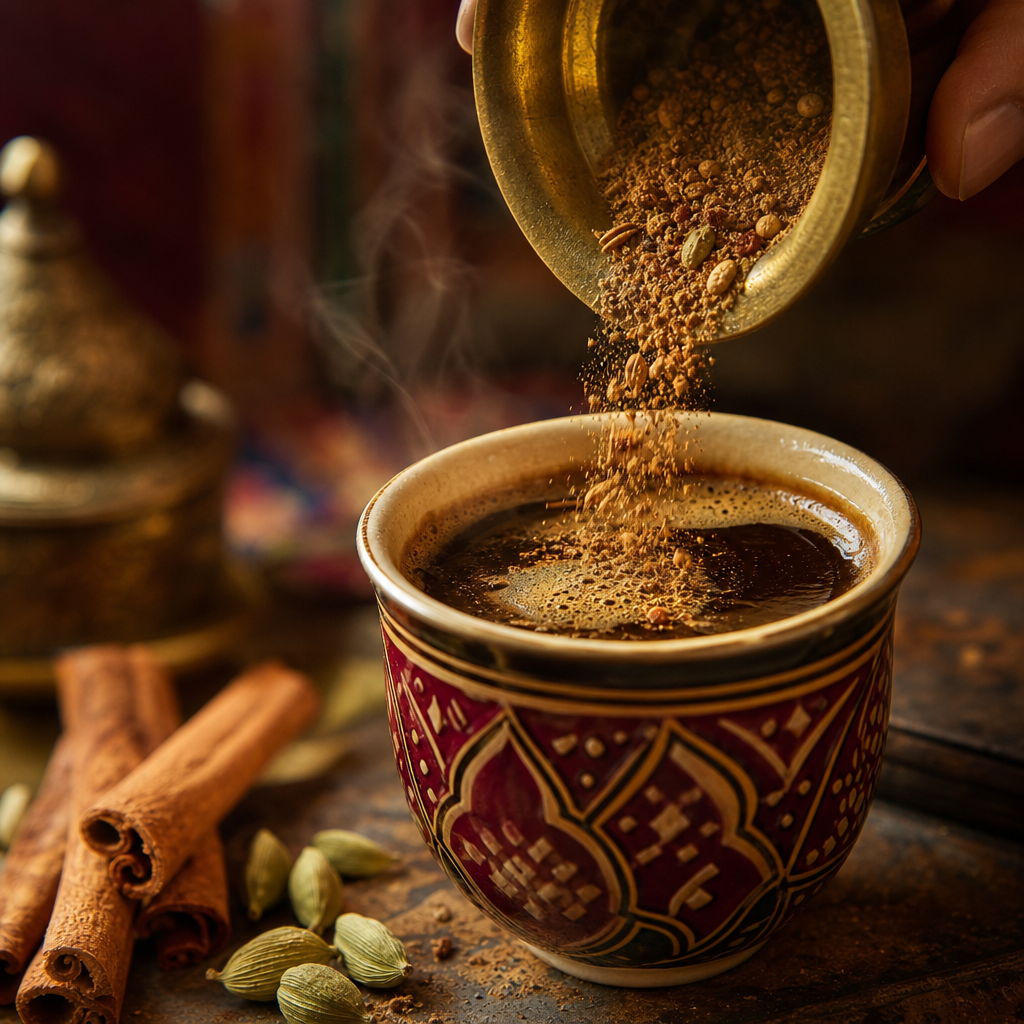
Unlike the stripped-back espresso culture of much of Europe, or the cold-brew minimalism that dominates modern specialty cafés, Moroccan coffee has always carried its ingredients openly. The most beloved preparation is café des épices, a coffee blended with warming spices that vary by region, by family, and by season. Cinnamon appears most consistently, lending a woodsy sweetness that softens the bitterness of dark-roasted beans. Cardamom adds a floral, almost piney brightness. Ras el hanout, the layered spice blend whose name translates loosely to "top of the shop," occasionally finds its way into the cup as well, bringing ginger, clove, and dried rose petal into quiet harmony.
What makes this tradition remarkable is its intentionality. Spices in Moroccan coffee are never an afterthought or a seasonal novelty. They are structural. They carry meaning, connecting a single morning cup to centuries of spice trade routes that passed through Marrakesh, Fez, and the port of Essaouira. When you drink a properly spiced Moroccan coffee, you are, in a very real sense, tasting geography and history at once.
The roasting tradition itself also tells a story. Moroccan green coffee was historically roasted at home in shallow pans over open flame, a practice called the home roast that gave households direct control over color and depth. Darker roasts were preferred in the south, where bold flavor stood up to heavily sweetened preparations. Lighter, more aromatic roasts appeared in coastal cities, where the coffee was drunk with greater restraint and paired with honeyed pastries called chebakia or msemen flatbread fresh off the griddle.
Ritual, Time, and the Art of Slowing Down
Perhaps the most defining feature of Moroccan coffee culture is its relationship with time. Coffee in Morocco is rarely rushed. The preparation is considered part of the experience, not a prelude to it. In traditional households, brewing coffee is a meditative act: spices are ground by hand, water is brought to a careful temperature, and the resulting brew is poured with deliberate patience, often from a height to encourage a slight froth. This pouring gesture, familiar also in Moroccan tea ceremony, is both practical and theatrical, a quiet performance of hospitality.
The setting matters as deeply as the preparation. Coffee is frequently served in small decorated glasses or ceramic cups glazed in the jewel tones of Fez pottery. It arrives on a hammered tray alongside a small plate of dates or almond-stuffed sweets. To refuse this offering is almost unthinkable. Acceptance of the cup signals willingness to sit, to talk, to be present. In this way, every cup becomes a social contract, an agreement between host and guest to inhabit the same moment together for a while.
In the souks and squares of Marrakesh, coffee culture takes on a more public and communal dimension. Street-side café culture is deeply embedded in Moroccan city life, particularly for men who gather on low stools around small tables to argue, laugh, play cards, and watch the world move. The coffee served here is strong, often sweetened with cane sugar stirred in before brewing, and it arrives quickly, its steam carrying the unmistakable perfume of cinnamon across the open air. This is not Instagram coffee. It is coffee as social infrastructure, the thread that stitches a neighborhood together morning after morning.
Where Moroccan Coffee Meets the Wider World
Morocco sits at a fascinating crossroads in global coffee history. As a country that imported rather than cultivated coffee, it absorbed influences from Arabia, sub-Saharan Africa, Andalusian Spain, and the Ottoman empire, weaving them into a coffee tradition that is distinctly its own. The Arabic coffee influence is evident in the use of spice and the communal serving style. The French colonial period left behind a café au lait culture that persists in urban Morocco today, where espresso mixed with warm frothy milk is as common in Casablanca as it is in Paris. Yet neither tradition fully displaced the spiced coffee of the home and the souk. They coexist, layered, the way Moroccan culture itself tends to layer old and new without apology.
This layering is also what makes Moroccan coffee so resonant for people encountering it for the first time. Travelers often describe their first café des épices as something that feels both unfamiliar and deeply comforting, as though the spices unlock a memory they did not know they had. Food anthropologists sometimes describe cinnamon and cardamom as having this effect, connecting drinkers across cultures through shared sensory recognition. Whatever the science, the experience is consistent: spiced coffee from Morocco tends to stop people in their tracks and make them want to understand where it comes from.
For nomadic coffee lovers, Moroccan coffee culture represents something increasingly rare in the global coffee landscape: a tradition that prizes community over convenience, depth over speed, and ritual over routine. In an era when coffee often arrives in a disposable cup through a drive-through window, the Moroccan approach feels almost radical in its warmth and its patience.
Brew It with SAFAR
At SAFAR, the spirit of Moroccan coffee culture runs through every product we craft. Our Marrakesh Cinnamon Blend, starting at ฿495, was developed to honor exactly this tradition: specialty arabica ground coffee blended with cinnamon that brings warmth and depth without overwhelming the cup. Brew it using a French press for a fuller body that lets the spice breathe, or use a moka pot for a bolder, more concentrated expression closer to the street-side café experience of Marrakesh itself. For best results, brew with water just off the boil, around 93 degrees Celsius, and allow the grounds to bloom for thirty seconds before pressing.
If you are looking for something portable that still delivers that same ritual quality, our Marrakesh Coffee Drip Bag, starting at ฿60 per bag, makes it possible to brew a spiced Moroccan-inspired cup anywhere: in a hotel room in Chiang Mai, at a co-working space in Bangkok, or on a slow morning at home when you want the ceremony without the complexity. Hang the bag over your cup, pour hot water slowly in three equal pours, and let the aroma fill the room before you take your first sip. Consider serving it alongside a small piece of dark chocolate or a date to echo the traditional Moroccan pairing of sweetness with spice. Order yours at safar.coffee and taste the difference for yourself.